Researchers from Cornell's College of Arts and Sciences used a new JWST transit-mapping technique to reveal WASP-17b’s slightly egg-shaped atmosphere and confirm predicted temperature patterns. The breakthrough creates a detailed 3D exoplanet atmosphere map and advances future studies of alien weather and climate.
Fred Young Submillimeter Telescope nears first observations as Cornell University scientists prepare groundbreaking surveys of the early universe, galaxy formation and dark matter. Prime-Cam, the largest submillimeter instrument ever built, will enable high-sensitivity studies of cosmic microwave background radiation, star formation and the Milky Way.
Cornell’s Spacecraft Planetary Image Facility recovered and is restoring lost MoonKAM lunar images requested by thousands of middle school students during NASA’s GRAIL mission. The Cornell University image library also trains researchers in planetary data analysis and preserves access to decades of spacecraft imagery.
Twenty new faculty have joined the College of Arts & Sciences this year, strengthening departments and programs with their wide-ranging expertise and filling numerous leadership roles for the College and university.
Cornell College of Arts & Sciences physicist and astronomer David Kornreich, Ph.D. ’01, died Aug. 30 in a plane crash near Ithaca while piloting his aircraft. He was researcher and science communicator known for galaxy studies and astronomy outreach.
NASA’s Psyche mission principal investigator Lindy Elkins-Tanton will deliver the 2026 Terzian Lecture, hosted by the astronomy department in Cornell's College of Arts and Sciences. She will discuss the spacecraft’s journey to the metal-rich asteroid Psyche and upcoming discoveries.
Together the Department of Astronomy and Cornell Center for Astrophysics and Planetary Science represent one of the world’s leading institutes for space science with over 110 active researchers. Research emphases include cosmology, solar system exploration, exoplanet science, and fundamental astrophysics. Graduate students, early career researchers and undergraduates, are actively engaged in current NASA missions, NSF consortia, and CCAT-Prime/FYST. The department and center also run an extensive and robust outreach program to the broader community.
Cornell scientists drive breakthrough astronomy
Since the early days of modern cosmic exploration, Cornell scientists have led the way, from guiding rovers through the red dust of Mars to searching for other life in the universe; and from modeling exotic stars to detecting the faint ripples of gravitational waves.
Astronomy offers a wide variety of world-class research opportunities in astronomy, astrophysics and space science, with strong multidisciplinary connections, and a friendly and supportive atmosphere.
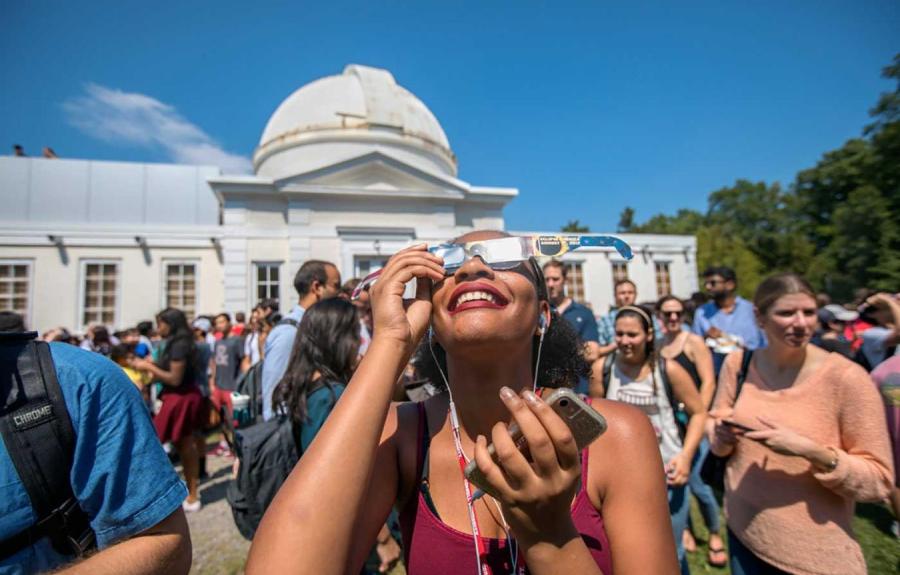
In the spirit of the renowned Cornell Professor Carl Sagan, the Department of Astronomy reaches beyond campus in numerous ways. The Spacecraft Planetary Image Facility (SPIF) is a repository of spacecraft data, a facilitator of research, and a hub for PreK-12 education and public outreach activities. Ask an Astronomer has been answering questions from the curious since 1997. The Cornell Astronomical Society conducts viewing nights at the Fuertes Observatory and offers educational programing to the public.